Category: Musings

  • Meet me at the bar for N7 Day

    BioWare, Public domain, via Wikimedia Commons

    It’s N7 Day once more, and alas, this time we’ll be meeting Garrus at the bar for it*.

    Since BioWare was shut down, I’ve started and deleted so many posts, both here and on social media. I’ve talked about it a bit on my Twitch stream, and in various private spaces, but I’ve struggled to dig into my feelings in a public way for a number of reasons.

    First, it feels selfish to make any of this about me. I know that isn’t what sharing my feelings does, necessarily, but it’s hard to argue that point with my emotions. And even saying this makes it feel like I’m centering myself, so, you know, just running in that brain hamster wheel like Shepard’s pet. Squeak!

    Second, talking about how much their games meant to me when hundreds of people are now out of work? Well, see point the first. These are folks who gave their hearts to all of us, and the company that benefited from that has cut those hearts out and stomped on them. BioWare employees deserve better. I am trying to keep my eye on where they land and can’t wait to see what they come up with next. But skill and experience aren’t helping as much as they should in this economy, especially with the way the games industry is going. So meanwhile, any support we can offer to keep them afloat as they find new jobs? Let’s do it.

    Third, there is just… so much I could say, I don’t know where to start. I feel like I need to write a stirring eulogy, a speech for the ages, and all I have is blood spatter fingerpaint.

    Dragon Age and Mass Effect live in my head and my heart. They inspired me to write fanfic and original fiction, to think about my craft more deeply and level it up accordingly. I study them and take them apart and examine all their bits and pieces, their lore and codices, their character histories and worldbuilding. I think about the ways the branching choices play out and impact events and people. I contemplate the components of their setpieces, figuring out how and why they function so effectively. I repeat the dialogue in my mind and wonder how I can reproduce the ways it makes me laugh and cry and want to punch people. I wrote a whole essay on the epic conventions used in Mass Effect, sadly lost to website shutdown.

    They’re not perfect, not remotely, but things don’t need to be perfect to resonate with us.

    Replaying the Mass Effect games got me through the worst of the pandemic. I started streaming them on Twitch so I could hang out with far-away friends and strangers who have become friends. They became an integral component of what I call “mandatory fun time,” where I disconnect from work for a few hours a week instead of constantly hustling. We coined the term “paragonning” for taking random stuff we find on the ground in games, because we found it hilarious that my very paragon Shepard kept engaging in casual thievery. I started replaying the Dragon Age games to take my husband, who had not played them, on a guided tour of my canon versions, which has culminated in Veilguard, where we are now.

    I’ve played through everything but Veilguard more than once—more than twice, in fact, some of the games mumble-many times, I hardly dare to admit. Thousands of hours of my life have been spent in joy and sorrow and frustration as I fought and triumphed and died and reloaded from the last save. I have my canon romances and my secondary favorites, the choices I’ll always make and the ones I’ll never touch***. Every time I go back to them, I find something new, something I missed, along with all the comfortable, familiar moments that still give me chills.

    The Chilling Effect books literally would not exist without both these sets of games; I’ve described Chilling Effect specifically as Mass Effect starring purple Hawke, because of how a down-on-her-luck nobody with a saucy mouth has to step up and fight above her weight class*. Drafting the trilogy was a way for me to process my thoughts and feelings about the games, as much as anything else I kitchen-sank into them. Trick Weekes, who supported my writing well before the book was even random gases hoping to become a star, took the time out of their busy life to blurb Chilling Effect.

    I genuinely cannot emphasize enough how big a deal all of this was to me, creatively and career-wise.

    Dragon Age II in particular, while perhaps one of the least-enjoyed games by the player base as a whole, remains one of my favorite. Of all the tragic back stories of the various characters, Hawke’s hit me closest to home, as a child and grandchild of people who fled their home country to escape violence. The way she’s treated, even as she works her way up from a nobody to a city’s champion, reflected some of the experiences members of my family had, things they were told by the people in their new home. That sense of being an outsider who still works hard to help and protect the people around her? It hits even harder now, in these political times, than it did when it came out.

    Even though I’m tearing up as I write all this, in some ways I’ve already mourned BioWare for years. Ever since Andromeda was released—and I really liked that game—the corporate crap surrounding the company made it feel like the end was inevitable. Like they were creating on borrowed time, and the hourglass sands were running out too fast. That we got the Veilguard we did instead of some multiplayer subscription-model monstrosity feels like a gift to me. I’m playing the game slowly because of how aware I am that once it’s over, that’s it.

    As sad as I am that we won’t have more BioWare games, the ones we do have are such a wealth of pleasure that I can’t feel too cheated. They have enriched my life in immeasurable ways, and I am so grateful for that. Will I play through them all again? Almost assuredly. Will I make different choices? Not likely.

    I could go on and on about my favorite characters and moments, the music, the level designs, but I’ve already perhaps effused enough for a single blog post. Or perhaps no amount of effusiveness could ever be enough; I am deeply, painfully capable of expounding on the topic for way longer than anyone wants me to. I once went off about Mass Effect for multiple hours in a bar at WorldCon whilst standing at a small table, after all.

    So when I say I’ll meet you at the bar, well, I kind of already did. But we can always meet there again. Just like old times.


    For those not in the know who still read this whole post, some footnotes and spoilers:

    *At the end of Mass Effect 3, Garrus says, “Not sure if turian heaven is the same as yours, but if this thing goes sideways and we both end up there, meet me at the bar. I’m buying.”

    **In Dragon Age II, you are given different dialogue options that are color coded, and the purple options are the charming/sarcastic ones.

    ***I will always headbutt the krogan who insults my perfect son Grunt, and I don’t punch the reporter because the verbal takedown that follows is so satisfying to me. The rachnai queen lives and so do the geth. Not Loghain, though, bye bro. Isabella is my friend, no matter how much is her fault, and Anders should have to suffer through the outcomes of his terrible choices. Leave Hawke in the Fade? Not a chance. And sorry, Viv, you will never be Divine as long as I am holding the controller.


  • How to accept compliments

    a round mirror surrounded by green and yellow leaves, the mirror reflects a blue sky with clouds and a hand holding a yellow and brown pansy
    Photo by Larisa Birta on Unsplash

    My friend Jay Wolf suggested I resurrect this exercise at Viable Paradise, as they found it especially helpful when they were subjected to it years ago. While it’s tailored to writers, I think it applies in many contexts where you might be complimented about something.

    It’s worth grabbing a mirror or a friend and practicing the suggested phrases until they feel natural to you. Add your own, if it helps!


    You are going to receive compliments about your work. Sorry not sorry, it’s going to happen. And you will probably feel awkward about it.

    The impulse to minimize compliments, to laugh them off, even to argue with them, is strong. Sometimes you think people are just being polite, not honest. Sometimes this is imposter syndrome making you feel ashamed or guilty: you have tricked someone into thinking you are worth complimenting! Ack! Sometimes this is cultural: a compliment must be deflected or bad luck will follow. Sometimes we feel pressured to reciprocate and we can’t think of a way to do so on the fly. Sometimes you don’t want to seem conceited, or you don’t want to take credit when you feel like you had help.

    Sometimes we just can’t accept it because we don’t think it’s true. Fundamentally, we disagree with the person complimenting us. We think we could have done better. We see all the flaws we didn’t fix. We hear all the sour notes. We taste how the spice ratios are slightly off, or the texture is too stodgy.

    I’ve heard different ways of trying to convince yourself to be okay with all these feelings. You can revel in the fact that you are tricking people, muahaha, release your inner villain. You can do affirmations until you are able to believe in your own awesomeness. You can call your mom and listen to a litany of your flaws until you feel like any bad luck has been mitigated.

    Ultimately, though, no matter how YOU feel, if you deflect, minimize, or reject a compliment, you are being rude and demeaning to the person complimenting you. You’re making them feel bad. You are telling them: you are a liar, you are a fool, your taste sucks, you like bad things. They are handing you a gift, and you are opening it and saying, “Ew, I don’t want this, get rid of it.”

    Did any of that sound good? I hope not. I am doing my best mom guilt attempt here while also channeling my therapist.

    I am, alas, not a therapist, so I can’t fix your feelings. But what we are going to do is practice receiving compliments gracefully.

    Repeat after me:

    Thank you!

    Thank you for the kind words!

    Thank you, I’m so glad you enjoyed it!

    Thank you, I appreciate hearing that!

    Thank you, that is lovely to hear!

    Thank you, that means a lot to me!

    Thank you, I love your work as well!

    One thing to consider is matching their enthusiasm level, if you are comfortable with that. If someone is being mellow, keep it mellow. If someone is excitedly bouncing around, maybe engage more deeply with what they like, let them talk more about specifics. If you are autistic or faceblind or otherwise have trouble discerning these things, it is totally fine to stay polite and professional.

    Keep practicing this until it becomes automatic. Even if, in the secret cockles of your miserable heart, you can never ever feel joy at being complimented, you can at least pretend you do. You’re a writer, you make stuff up all the time. Go with it.

  • How to make an author website

    overhead/satellite/drone image of three houses in various stages of construction against a sandy dirt background, the house on the left has its roof struts framed out, the middle one just has some walls, the one on the right is only the concrete slab
    Photo by Iain on Unsplash

    Let us pretend I do not need to convince you of all the important reasons to have a website. You are ready to do it, but are not quite sure how. Here is the fastest and easiest way to do the thing in a moderately professional manner, in my personal experience.

    First, you need a domain. There are many places to purchase one, all with different pros and cons. Sometimes you can get a domain bundled with the website itself, one-stop shop, very convenient. Sometimes that locks you into dealing with a company you may want to divest from later.

    I recommend porkbun.com as a straightforward place to do the thing. It costs approximately $11-$13 per year to buy a domain. If you can, stick it on auto-renew so you never accidentally forget and lose your domain to some jerk who wants to sell it back to you for $$$.

    Next, you need a website. For this, I recommend Carrd.com unless you want to have a blog. (If you do, then some WordPress variant is likely to be your best bet.) Carrd has yearly Black Friday sales where a whole year of website hosting costs $11. Yes, you read that correctly. It may even be that the $11 gets you a domain as well, if I understand their new terms. The regular price is $19 a year, or you can pay $49 for additional bells and whistles.

    So, total cost for domain plus hosting for a year: approximately $30-$60 (or $11 if that Carrd deal is real and your timing is good).

    Yes, you can do free things. There is a free Carrd option, there are free WordPress options, free other places. There is no shame in free. Free is better than nothing. If you can find the money, though, the upgrade is worth it for that extra veneer of professionalism, and to ensure you have an easy-to-find digital home.

    What should you have on your website?

    1. Your name.
    2. A bio. It can be as long as you’d like, but 75-100 words is a frequent limitation when you’re asked for one for publication purposes. You may also want to have a separate “press kit” section with multiple bios to choose from, of different lengths and styles.
    3. A headshot. You can skip this if you don’t want to be perceived, but it’s useful to at least link to a file that can be downloaded by folks who might need it.
    4. A list of publication credits, if you have them, with applicable links.
    5. Links to your social media accounts.
    6. A contact form. You can just put an email address, but that way lies spamming more than a form. You do want people to be able to contact you with legitimate business offers, though.

    That’s it!

    Make a date with yourself and slap this together using a template that appeals to you. Personalize it as much or as little as you want. Borrow ideas from other writer pages you like. Don’t be afraid to keep it simple! Any site is better than no site, and the easier it is to navigate, the better.

    Don’t use AI to generate graphic design elements; using AI in one place is a red flag that you may be using it in others.

    Ultimately, this is your digital real estate, your business card, your personal brand, a way you can quickly convey who you are and what you write to people who want to know more. Perfect is the enemy of done, so get it done.

  • Be more dramatic, ironically

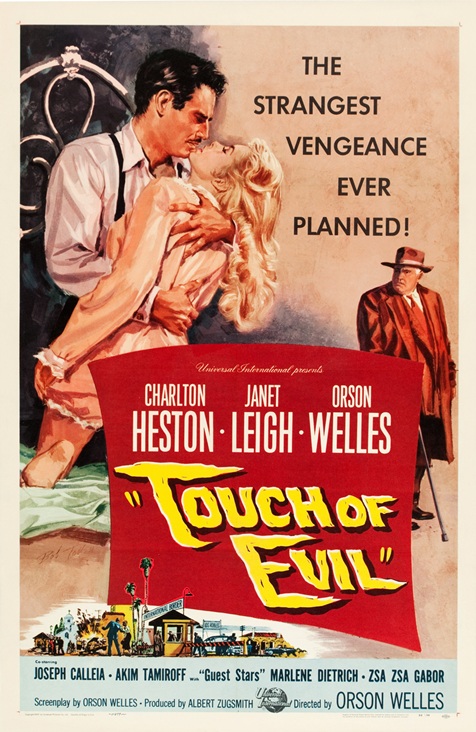
    1958 poster for the film Touch of Evil, featuring an improbably Mexican Charlton Heston embracing a limp Janet Leigh while Orson Welles rocks a red fedora and suit and the iconic bomb scene is depicted in tiny shapes at the bottom

    I posted this writing rant about twists and dramatic irony on Bluesky a few days ago, but it seemed useful to drop it on my blog as well, for posterity if nothing else! With some editing and expansion, of course.

    I was inspired by Gwenda Bond sharing this piece about single vs dual POV in romance novels. Beyond the useful thoughts about what each approach accomplishes, it touches on the concept of dramatic irony, one of my favorite literary techniques.

    If you know me or have met me, you’ve probably heard me repeat a lecture on twists my TV writing teacher gave my class over twenty years ago. It was delivered at the height of the Shyamalan twist, which many college students in the film program attempted to replicate, with mixed results.

    M. Night Shyamalan didn’t invent the twist; at a minimum, we’ve got plenty of Twilight Zone episodes predating his work. I think, though, that when someone successfully executes a specific technique, there’s this ripple effect, a broad urge to try it as well. We’ve seen it with mystery/puzzle box shows, as another example, which is a whole other lecture I’m sure the same professor delivered later, when those got huge.

    Anyway.

    Twists became the lynchpin holding a lot of student scripts together. Instead of artful suspense and tension, many stories were basically:
    1) Setup
    2) Action
    3) Twist
    4) Please clap

    The ubiquity of twists primed us to expect them, which in turn made us apply our story brains to guessing them in advance. We were students! It was our job to dissect stuff and figure out how it worked. Sometimes this ruined our ability to simply enjoy stuff; sometimes it made us better able to appreciate good craft.

    If twists hadn’t been so common, maybe it would have been fine. Maybe our professor wouldn’t have felt compelled to intervene. But he did, and here’s what he said.

    Twists are extremely difficult to execute well. If they’re too obvious, the audience can see them coming from a mile away. We feel bored, or insulted that you thought we’d fall for it. If they’re too out of nowhere, the audience feels dissatisfied because you basically tricked us, and not in a fun way. You pulled the rug out from under us; you painted a fake tunnel on a rock wall and chuckled cruelly when we ran into it.

    In either case, audience expectations haven’t been met. You promised us a king cake, and instead we got a cake wreck, or a pile of rocks. The path between these two outcomes is a tightrope stretched across a ravine.

    Surprise is good and desirable, but it’s not as useful as tension. Suspense. The anxious mixture of feelings you experience as you wait to see what happens to characters or a world you’re invested in. The cathartic release when the arrow that was loosed from the bow finally hits something.

    Waiting for a twist to be revealed is a form of suspense, but as noted, the failure modes are not cathartic. They’re frustrating, annoying, unsatisfying. If you spend the whole time waiting for everything you know to be reversed or undermined, your attachment to the subject is diminished. Your enjoyment, instead of being ongoing throughout the story, becomes contingent on the final form of the twist and whether you like it.

    Dramatic irony is the solution to this problem—or a potential one, at least. You give the audience information the characters don’t have, which creates natural tension as we watch actions being taken and choices being made without essential knowledge. The suspense is in waiting for the fictional people to catch up, or not, as the case may be. What will they do differently when they’re finally enlightened? Will it change anything? Will it be too late? What happens if they never learn?

    If the audience is in on the trick from the beginning, we’re not being insulted by a bad twist the writer thinks we’re too obtuse to expect. We’re not being subjected to a random outcome we never could have predicted. We know, more or less, where the track leads, and we’re along for the ride, to see how exactly it crashes or how someone manages to save the day. We can still be surprised by what happens along the way, the nuances of character interactions, the specific details of the consequences and setbacks and so on.

    Romances with dual POVs are one easy example of how dramatic irony can be effective. As the linked article above notes, we lose the single-POV sense of uncertainty experienced by the main character, who can only speculate about the unrevealed thoughts and feelings of the love interest. However, we gain interiority that allows us access to the logic driving the various decisions and misunderstandings typical of the genre. There’s a frisson of delighted frustration in watching two people fail and flounder and ultimately figure it all out.

    There’s also the kind of edge-of-your-seat suspense you can derive from a well-placed imminent explosion, literally or figuratively. Touch of Evil by Orson Welles begins with someone putting a time bomb in the trunk of a car; this is followed by a single long take of just watching that car drive, waiting for the bomb to go off. We don’t know where the car is going, or why the bomb is there. We don’t know what will happen in the aftermath. Those are some of the most tense few minutes of cinema ever made, even though virtually nothing happens, because of the dramatic irony created by the setup.

    This is not to say that twists are never allowed, or that no one is dissatisfied by dramatic irony. Failure modes can be things like individual scenes or the whole situation becoming painfully cringe-inducing, such that you don’t want to watch anymore. It can also become unreasonably farcical, breaking suspension of disbelief—say, because the characters remain ignorant even though it would be incredibly sensible for them to figure stuff out at various points.

    For a class full of budding filmmakers, though, this was a lesson we really needed. It freed us to think in different forms and structures, to use the right tool for a given task instead of trying to apply the same hammer to everything. And clearly, I’ve never forgotten this! Hope it can help you, too.

  • When life gives you floor pie

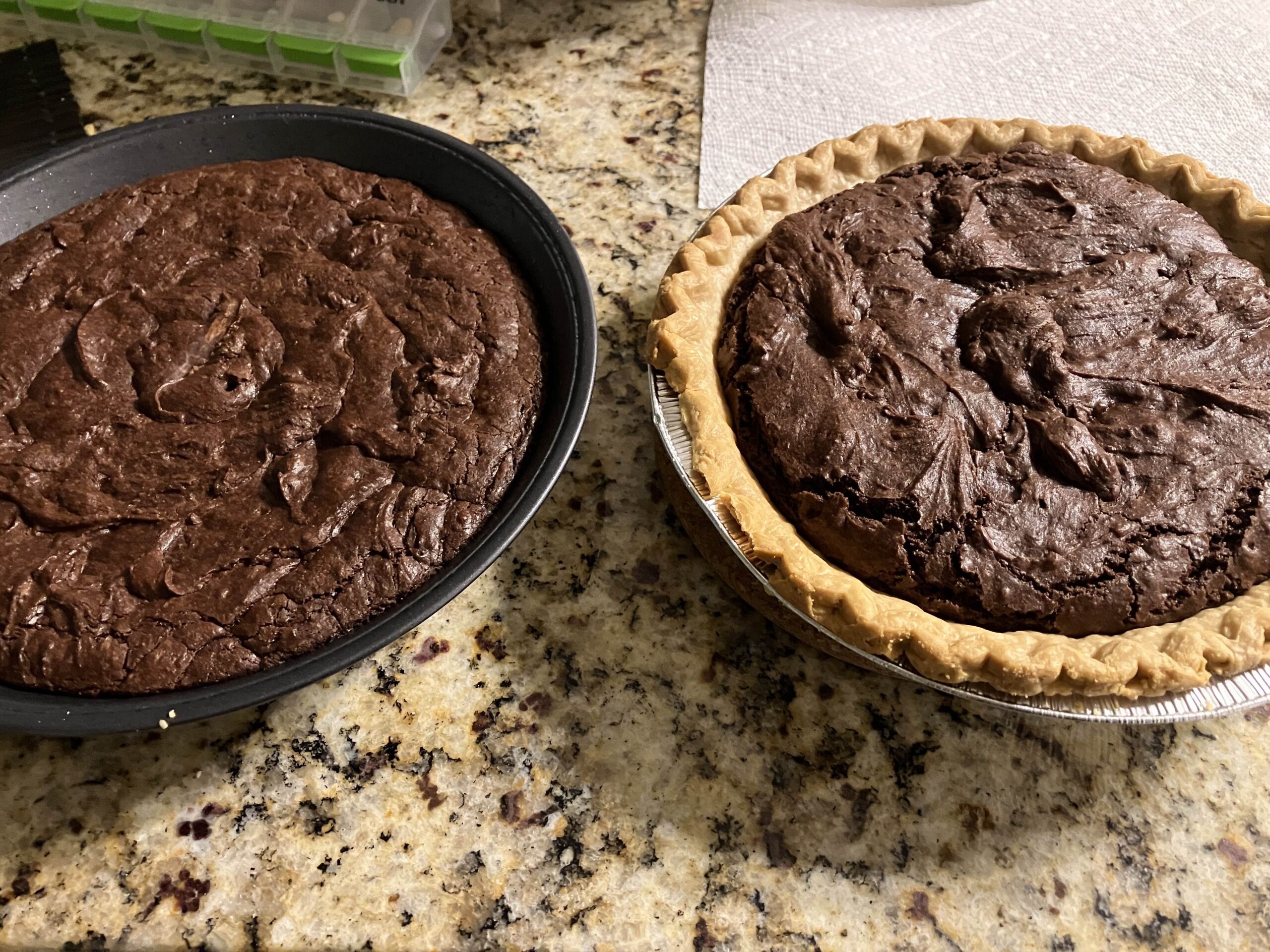
    Brownies baked in a round pie tin next to a brownie pie, on a granite countertop, with a peek of my daily pill container in the upper left corner and a random paper towel in the upper right

    Sometimes life drops a lesson on you, figuratively and a little literally.

    The other day, I realized we were out of sandwich bread, so I set about baking some. Nothing fancy, just two loaves of white bread. I have a stand mixer with a dough hook and everything! Easy peasy.

    My husband went to Costco to pick up our monthly-ish bulk groceries and sundries. He came home with a not-unreasonable quantity of frozen items… unfortunately, that same week, he’d already stocked up on different frozen items from the regular grocery store.

    Our freezer is not the TARDIS, alas. It is not bigger on the inside.

    I played freezer Tetris long enough to lose feeling in my fingers, and eventually managed to fit everything. Almost everything. No matter what I did, how I smooshed and shoved and stacked, one thing could not be contained: a two-pack of frozen pie crusts.

    The fastest solution would have been to throw them away and move on, but I hate waste. And so, because life gave me pie crusts, I decided to juggle bread making while also baking some pies.

    At this point, I had already plopped the bread dough into a bowl and it was proving for the first time. This meant I had a timer going, and when time was up, I’d have to punch and knead and split the dough into two baking pans for the second rise.

    And also bake two pies. No biggie.

    As inconvenient as this was for me, as much work as it made, my family was naturally delighted by the prospect of both bread and pie. Well, my daughter wasn’t, because she doesn’t really like pie crust, but she does enjoy scraping out the filling. We even had leftover homemade whipped coconut cream, waiting to be dolloped on top.

    The vegan brownie pie I make requires that I prebake the crusts for a bit, so I did that while I assembled the other ingredients and kept an eye on my rising bread dough. I had to make a double batch, and all the measurements were in metric, so there I was, converting and mathing and measuring and pouring, melting chocolate and sugar in my rigged double-boiler, a.k.a. a metal mixing bowl held with an oven mitt over a pot of boiling water.

    Did I mention I have ADHD? Ah, well, nevertheless.

    I was managing. I finished the chocolate filling as both the pie crust and bread alarms went off nearly simultaneously. Deciding the bread could wait, I set out trivets, put on my trusty oven mitts, and started taking out the crusts. One down, one to go, and then…

    My daughter ran into the kitchen. With the oven wide open, me leaning inside pulling out a pie tin.

    My husband shouted. I startled. Down went the pie crust I fumbled in my alarm. Splat. Floor pie.

    I closed the oven and took a deep breath. Now what? I had two pies worth of filling solidifying in the bowl, and one crust. And the bread dough waiting for me to give it a hearty smack.

    I also had an empty pie tin in my cabinet. So I got that out, greased it up, and poured in the filling sans crust. One brownie pie, one… Just brownies, I guess.

    You may remember from a few paragraphs back that my daughter likes pie, but not crust.

    So, let’s review. My husband interrupted my bread making with too many freezer things, which meant I had to bake pies. Happy husband and son! I dropped one of the pie crusts whose inability to fit in the freezer led to emergency baking, and had to make one “pie” without crust. Happy daughter!

    The only one inconvenienced was me, and in the end, that’s all it really was: an inconvenience. No one was injured, one half-baked pie crust was lost to gravity.

    There’s a life lesson in here somewhere. About not giving up. About being able to pivot when stuff happens, about being flexible, about plans going wrong sometimes leading to new plans going right in unexpected ways. About managing frustration and failure, and seeing opportunities in accidents and mistakes.

    Maybe it’s just a story about bread and pie. That’s okay, too. When life gives you floor pie, make brownies.

  • One week to Witch You Would!

    Magician woman standing in front of a curtain throwing a deck of cards into the air, but almost all the cards have been replaced with the cover of Witch You Would
    Sydney Sang from Pexels with some modifications

    Time flies, much like a cartoon Elizabeth Montgomery on her broomstick. It’s been a million years since Witch You Would was announced, but now merely a single week remains until it comes out. To celebrate the release, join me on my Twitch channel on September 2nd at 9pm ET as I read from the book, answer questions, and have a secret surprise giveaway.

    I’ve talked a bit about how this book started and how it evolved, and how the cover came together. What I haven’t talked about as much is the ways this book strikes a few personal chords for me.

    Even when writers are writing about characters who are very different from ourselves, there are often still some core elements that, intentionally or subconsciously, reflect parts of us. We may not be holding up a full-length mirror, but we may be peering into a warped funhouse glass that exaggerates some qualities and minimizes others. We may be crafting silhouette portraits, or caricatures, or the darkest timeline versions of ourselves. We may even be Frankensteining parts together to create new wholes.

    The two main characters in Witch You Would reflect a lot of my anxieties, and the ones I see in people around me. The fear of failure, of screwing up and not being able to fix it. The fear of being authentically yourself, only to be rejected because of who you are or aren’t. The fear of being stuck in the same dead-end grind with no way to improve your life. These are people who want to do more and be more, become better versions of themselves, and they’ve worked and lucked into having that chance—but it’s still not guaranteed, and that scares them.

    So many people today don’t have the same opportunities, and are just getting by as best they can. We take risks, we hustle, we’re told we can do anything and be anything, and then reality kicks our asses. It’s a very millennial experience, I think, and one that younger generations are growing up in, maybe not realizing things weren’t always like this. And they don’t have to be, but there’s only so much we can individually do. We still keep trying, though, and passing around the hat with the same twenty bucks inside.

    People who know me and my husband may also notice some shared elements in the romance and the vibe between the characters. I’m the overthinker who makes lists and nerds out about random stuff, my husband is the goofy performer always ready to drop a bad pun… and vice versa, to a certain extent. When high school superlatives were handed out, we were both voted Funniest; we’ve both made each other do a spit take, more than once. His task lists can get longer than mine, and he’s been known to go on deep research dives when buying a product the same way I do when I’m trying to get some tiny detail right in a book. But in the end, we’re a team. He’s definitely the one with the outrageous mustache, though.

    Penelope and Gil both also feel responsible for continuing the legacy of their grandparents, in their own ways. The story of Penelope’s family in particular, especially who her abuela was and what she was like, is drawn from my own family history. My abuela lied about her age to get an education, worked her way through nursing school, and kept working even after she married a doctor and could have become a housewife instead. She supported our family when they emigrated from Cuba, and was a school nurse until she retired.

    I have so many good memories of sitting in the kitchen, listening to her sing off-key while she cooked, learning how to make rice and beans or packing Cuban coffee into the cafetera. Watching her stick toothpicks through avocado seeds and coaxing them into sprouting on the windowsill. Like Penelope, I still have one of her cookbooks. Losing her to dementia was a long, slow journey that hurts to remember because of how vibrant she always was, and how she shrank into herself, that color and joy seeping away and fading. Writing a version of her into this book lets me remember the happy times, the bright times, as well as the sadder ones.

    I could say more—about friendships, and siblings, and film people, and cafecitos, about kitchen fires and botanical gardens and the “real” Miami in all its myriad forms—but I should probably leave some things for you to discover when you read the book. You won’t have to wait much longer!

  • What a World(con)

    This year’s Worldcon ended on Sunday, with a sadly typical series of unfortunate events occurring at the Hugo ceremony. Other folks are talking about that, and while I certainly agree with the chorus, adding my voice to it seldom feels necessary. I’ll say instead: check out the amazing khōréō and So Let Them Burn by Kamilah Cole.

    I attended virtually this year, and got to see a lot of interesting panels and speakers. I’m not sure I can do any of them justice in a recap, but topics ranged from medieval astronomy to sex in dark fiction. Thankfully, the Discord server is staying open long enough for me to pull notes together so I can peruse them at my leisure later.

    A big part of the fun was getting to chat with other attendees in the Discord, both during and between events. It’s one of the reasons people go to conventions: the camaraderie. You’re not merely ships passing in the halls; you’re travelers journeying together, exchanging stories like Chaucer’s pilgrims, bonding over shared interests and diverse experiences.

    Big thanks to everyone who attended my reading; I hope you enjoyed the sneak peek of Witch You Would! And thanks also to everyone who came to the panel on writing classes and workshops, which was a wonderful and informative conversation among the panelists. I’m going to add a few things to my Resources page based on what was discussed, and if anyone wants my longer notes, just drop a comment.

    Two weeks to book birthday! Gasp!

  • Scenes, sequels, and degrees of disaster

    Photo of a person hanging from a nearly horizontal cliff face above the ocean, other distant mountains in the background
    Photo by Hu Chen on Unsplash

    I got an email from a writer who took one of my classes, and who wanted to know how to take a plot outline and turn it into chapters and scenes. I linked them to an anatomy of a scene post that I think does a good job breaking down one useful and streamlined approach to scene structure*.

    This method posits that every scene should have three components: a goal, a conflict, and a disaster. Essentially, you should have a character trying to accomplish something, struggling against obstacles and antagonists, and ultimately failing to achieve their goal. That failure leads to the sequel, which is a different kind of scene in which the character reacts to what just happened, is faced with a difficult choice, and decides how to move forward. That leads to another scene with a new goal, etc., repeat this cycle until you reach The End.

    The “disaster” part described in the link above is also sometimes called the try-fail cycle. If the character simply succeeds at their goal every time, there may not be enough tension and suspense to keep the reader turning the page. But if all they do is fail, then you don’t have a story, either, because they’re just spinning their wheels.

    Here’s where I like to apply a model I learned from tabletop gaming. Instead of a disaster, each scene can end with an outcome ranging from extreme failure to extreme success.

    The failure can be simply that the character didn’t manage to do the thing they set out to do; the mountain pass is blocked, and they have to find another path, perhaps a more dangerous one. Or they can somehow make their situation worse than it was when they started; they trigger an avalanche that sweeps them off the mountain and buries them under a ton of snow, and now they have to dig themselves out before they suffocate.

    They can also have a qualified failure or success. Maybe they don’t manage to achieve the goal, but their failure points them in the right direction or provides some useful boon or new ally. The mountain pass is blocked, but a strange hermit will guide them… for a price. Or they succeed, but at a cost that immediately affects them or will become a problem later—an injury that needs treating, a new enemy on their trail, a Chekhov’s gun that will go off at the worst possible time.

    They can also do the thing by the end of the scene, even if it’s difficult and they try and fail at least once, or they can do the thing stunningly well because they’re awesome and why shouldn’t they. Sometimes you do have to let your characters showcase their talents!

    Usually, the qualified failures/successes are the most versatile scene outcomes, because they maintain tension but also keep the plot moving forward instead of hitting a wall. But you do want to sprinkle in the other options at the places where they’d be most dramatically appropriate.

    If you’re going by a beat sheet, for example, then a total failure scene should probably happen around the midpoint and/or during the All Is Lost/Dark Night of the Soul beats. You might have an amazing success at the midpoint instead, only for the victory to end up souring, or the character’s arc being one where the success at their goal isn’t the end of their story. You might even have multiple goals and outcomes within a scene, some succeeding and some failing, though you have to be careful not to cram too much in one place.

    The degrees of disaster, their vibes and variations, will depend on what kind of story you’re trying to tell. A grimdark story may have more total failures with terrible consequences that really twist the knife; a romcom may have more funny fail-forward situations; a political space opera may have complex machinations where each win or loss causes both visible and unknown ripple effects.

    Your goal, as the writer, is to keep the reader interested and invested in every scene. As long as you’re doing that, you’ve succeeded!

    *Not the only way, certainly. There is no One Right Way, and as the saying goes, anyone who tells you otherwise is selling something.

  • Yelling for the cheap seats

    Photo of a theater as seen from the stage, part of the stage at the bottom and rows of red upholstered seats rising up to the back/middle of the photo, with the balcony seating at the back/top along with the lighting along the ceiling
    Photo by Kevin Schmid on Unsplash

    There’s a writing concept that I’ve seen people describe in a few different ways. The one I repeat the most, which I learned from my friend Jay Wolf, is, “Yelling so the people in the cheap seats can hear you.” Another, via Bree and Donna of Kit Rocha, is “dropping the anvil.” Yet another, more distant but still related concept, is “writing for the second screen*.”

    What do I mean by all these things?

    When you’re trying to convey something essential to the reader, you have to make sure they pick up what you put down. If you don’t, they may get confused or upset or disengage from the story.

    Everyone reads differently, and it can vary by day or mood or a million little things. Some readers—friend Jay calls them “close readers”—catch subtle hints, innuendos and subtexts and casual references that are mentioned once and never again.

    Others—call them “loose readers”—aren’t reading as carefully, for any of many reasons: they’re tired, they’re speed-reading, they keep getting distracted or interrupted, there’s a lag between reading days or times. Still others are skimming, scanning, reading mostly the dialogue, skipping to the saucy bits.

    Because everyone is reading your work differently, it’s worth—within reason—finding ways to accommodate those differences as you write, to make sure as many people as possible are getting the essentials.

    You yell so the people way in the back of the theater can hear you, not just the ones in the front row. You drop the anvil so the people who didn’t notice your more delicate hints are sure to spot that one. You use techniques that allow the people experiencing your work like it’s a second screen—multitasking, being interrupted, surrounded by noise—to catch what’s important instead of missing it.

    A prime example comes from my new book, Witch You Would. Multiple readers have asked the same question: can anyone in this world do magic?

    The short answer is: yes! It’s mentioned on page two, quoted in the section below, in which a customer is being nasty:

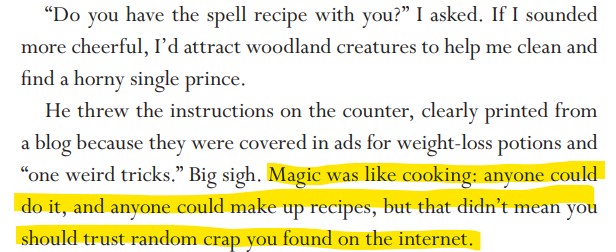
    “Do you have the spell recipe with you?” I asked. If I sounded more cheerful, I’d attract woodland creatures to help me clean and find a horny single prince. He threw the instructions on the counter, clearly printed from a blog because they were covered in ads for weight-loss potions and “one weird tricks.” Big sigh. Magic was like cooking: anyone could do it, and anyone could make up recipes, but that didn’t mean you should trust random crap you found on the internet.

    So if the answer is right there (and in a couple of other places), how did so many people miss it?

    Because I didn’t yell it for the cheap seats.

    What are some ways to accomplish this? A few ideas:

    1. Repetition. If you only say a thing once, some people are sure to miss it. If you repeat it a few times, in different ways, each repetition increases the odds that more people will catch it instead of having it whoosh past them.
    2. Clarity. The more obvious and direct you are about saying a thing, the more likely it will be that people understand it. Don’t only be ambiguous, or subtle, or sneaky: say it loud and proud somehow, somewhere. Drop that anvil.
    3. Placement. Where you say a thing can make a huge difference in how many people notice and remember it. Dropping vital intel at the end of a paragraph, or in the middle of a complex sentence? Might as well hide it under a rock.
    4. Pacing. If you say too many important things all at once, readers may only absorb the first one or two. Spread out your revelations and lore drops. If they’re all anvils, you’re going to give someone a concussion.

    These techniques can be especially useful—and extra necessary—if you’re deviating from genre standards and expectations somehow. The more people have particular tropes or concepts entrenched in their subconscious, the harder you have to work to make them understand that you’re doing something different.

    Take my example above: readers are primed to expect magic to be hereditary, or granted as a gift or curse by some powerful being or artifact, or have some extremely specific rules system you have to learn. That means I have to repeatedly and clearly say how it actually works in my book, or how are readers expected to know?

    This doesn’t mean you can’t do subtle, drop hints not everyone will catch, or let readers read between some lines. There’s so much potential for satisfaction in noticing some bit of foreshadowing that pays off later, or rereading and seeing everything you missed the first time. It’s about conveying the things you think they MUST know so that as many readers as possible will get them.

    And if you’re writing books for only the most discerning of palates, readers who can taste all those different flavor notes in your complex wine? That’s okay, too! Knowing your target audience for lets you cater to them accordingly. Are you writing for the smoothie drinkers, or the slow food crowd?

    Have any other techniques or tips for how to project and pitch heavy objects at reader heads? Share them in the comments, or drop me an email, or tag me on socials if you’re so inclined!

    *Longer explanation of the second screen thing: a lot of TV and film writers are being asked to write in a way that ensures people who are treating their TV as a second screen—as in watching something while also staring at their phone, or working on their computer, or doing something else—are still going to get the gist of what’s happening. This is why sometimes you’ll have, say, a character repeat something another one just said, or describe something you can clearly see on the screen.

  • Writer lies and cloudy skies

    Like a lot of writers and other artists, I deal with imposter syndrome, and not the kind where I toss little colorful astronauts out of airlocks. I have this spark of hope that maybe, actually, I’m not bad at creating stuff, but I also have a black hole of dread and shame and fear of rejection that swallows the spark faster than a puppy snarfing up food dropped on the floor. Every success is a fluke, every compliment is a lie, and anyone who is fooled into thinking anything positive about me or my work will soon realize they’ve been duped*.

    One of the techniques used in The Artist’s Way to help people deal with these, to use an extremely scientific term, “badfeels,” is creative affirmations. The actual list in the book is strongly spiritual—”I am a channel for God’s creativity,” “My dreams come from God,” and so on—but more generally the text explores the idea of replacing negative beliefs and self-talk with positive statements. These can be things like “I deserve love” or “I deserve fair pay” or “I deserve a rewarding creative life,” but they can also be compliments like “I am a brilliant and successful artist” or “I have rich creative talents.”

    When our brains object to these statements, we’re supposed to write down those objections and try to figure out where they came from. Who hurt us? Who made us doubt ourselves? Who told us the mean things that we’re now repeating back to ourselves? That exploration is meant to be cleansing, an emotional enema that will then allow us to believe in the affirmations instead of rejecting them.

    For some people, this absolutely works. I wish I was one of them.

    For me, affirmations are lies I’m trying to tell myself. No amount of external assurance or internal arguing will get rid of this conviction. If you tied me to a chair and clamped my eyelids open and forced me to watch video after video brainwashing me into believing “I have rich creative talents,” I can assure you, my droogs, I would go full Clockwork Orange on myself within days.

    It comes back to trust. I already struggle to trust myself, so telling me I have to convince myself of things I believe to be untrue simply reinforces that I am not to be trusted. It’s the emotional equivalent of pulling myself up by my bootstraps; it can’t be done, and it ends in frustration and pain.

    It also becomes a vicious cycle. I try to tell myself a positive thing; I reject it as a lie that I’m just telling myself so I’ll feel better; I lose trust in myself because I know I’m lying to myself, making me a lying liar who lies; future attempts to tell myself positive things are rejected even harder. All I’m doing is eroding any trust in myself, and that erosion spreads from my creative endeavors to all aspects of my life and thoughts and feelings. If I’ll lie to myself about this, what else?

    I don’t spend all my time wallowing in a pit of despair—not about this, anyway—so clearly I have developed coping strategies that allow me to get my work done. Maybe they’ll work for you, too.

    The thing I do most frequently evolved from a technique I learned from a meditation app: noting. It goes like this: I have dark thoughts about myself, my writing, my career, whatever. I have to get stuff done in spite of the thoughts. I note that I’m having those thoughts, the same way I’d note the weather outside my house. “Look, it’s raining.” “Look, there are those ‘my writing sucks and I’ll never amount to anything’ thoughts again.”

    I don’t force myself to ignore the thoughts, because that actually ends up paradoxically putting more focus on them and thus they stick around longer—it’s like yelling “I’m not looking at you!” at the rain, which, to do that, you’re kind of definitely looking at it, aren’t you? Or at least covering your eyes and thinking about how you’re not looking at it, no sir. And arguing with them? Same deal: then I’m having unpleasant conversations with the voices in my head, and I really would rather be writing, or cleaning my bathroom, or doing almost anything else that is either more productive or relaxing.

    Instead, I try to shift my attention to the thing I’m supposed to be doing, even though those thoughts are still there, the same way I’d look away from the window as it’s raining outside. The rain hasn’t stopped, I’m not ignoring it per se, it’s just there but I’m not staring at it. I’m starting a sprint timer, possibly in a Discord with other people or while watching a Twitch stream, and I’m getting back to work.

    You may have seen a comic at some point, of someone yelling “I don’t like thing” and then the clouds part and an angel descends from heaven and hands them a piece of paper, upon which is written, simply, “ok” in block print. Noting is basically me, the angel, handing my moody brain that piece of paper and then returning to heaven to get back to my angel duties. The yelling person isn’t gone, but I’m not standing there letting them continue to yell at me. I acknowledge them, and I move on.

    It took a lot of practice to get this technique to work consistently, but it’s been way more successful for me than affirmations because I’m not actually telling myself anything. I’m not trying to force my thoughts to be positive, or convince myself that my badfeels are wrong. All I’m doing is… working anyway.

    Is it spite? I don’t feel spiteful, but maybe it’s a little bit that. I think, weirdly, it’s more similar to defeatism, or perhaps acceptance. Maybe I can’t stop that mean little voice, but I can put my headphones on, crank up the lo-fi beats, and let it fade to background noise.

    Sometimes, going back to The Artist’s Way methods, sharing the badfeels with friends can also help me move past them. I can say, “I’m feeling like crap today in this specific way, I know it will pass, but I had to get it out.” And they’ll remind me that, yes, it will pass, just like the weather does, eventually. And even if it doesn’t, I can grab an umbrella or a raincoat and go get the groceries anyway.

    Okay, this analogy is getting away from me, but you see what I mean.

    Can “writer lies” ever work? For some people, absolutely. And some ways of constructing them may succeed better than others.

    A friend of mine (AJ Hackwith) coined that term, specifically, for the “lies” we tell ourselves to be able to get our writing done. They can be things like, “I’m going to pretend I’m writing a fanfic of my own story,” or “I’m only going to write two sentences and then stop.” These may not even be lies, technically speaking; maybe you ARE going to treat your story like it’s a fanfic, or you’ll stop after two sentences instead of getting hyped enough to continue. Part of what makes the assertions work is that seed of truth or possibility.

    Which leads to the next note, which I got from someone (Susan Alia) on Bluesky: sometimes an affirmation can work if it’s built on something you know to be true. One example that I’ve deployed, to mixed success—because, again, affirmations are not For Me as a rule—is, “You’ve done this before and you can do it again.” I tend to use it when I’m having, perhaps not writer’s block exactly, but writer’s inertia, where I can’t make myself start working out of fear that the writing will be bad.

    The first half of that affirmation is demonstrably true; I have written many things! There’s a whole page on my website dedicated to the ones that have been published. It then stands to reason, even if it’s not certain, that the second half of the affirmation COULD be true, that the odds of it being true are good enough that if I get back to work, maybe I can MAKE it be true.

    Ultimately, that’s what this all comes down to: building our truths, and weathering our storms. You may not be able to shut down intrusive thoughts, but you also don’t have to stop what you’re doing and give them your attention. You may not be able to chant the rain away, but you can close the curtains, make some tea, take your meds, and let the clouds do their thing while you do yours**.

    *As a side note, a thing one of my therapists mentioned regarding compliments: if I reject a compliment that someone gives me, I am effectively calling that person a liar. Am I actually going to sit here and consider all my friends and all the fans of my work to be liars? Or fools that I’ve somehow tricked into liking me or my art? Of course not! That’s really messed up! Thinking about my imposter syndrome this way helps me get past it when it flares up, because I am highly susceptible to guilt even if logic doesn’t always work.

    **People who are in a crisis situation should not be reading this and going, “But I am stuck outside in the rain and I have no way to get dry, so this makes no sense!” Or rather, yes, that’s the natural response, because if you’re in a crisis situation then the first thing you need to worry about is finding a way to get out of the crisis. This is not an essay for people who need solutions to extremely serious life problems; this is not a “this, too, shall pass” or “just keep swimming” or “stay positive” kind of reply to hardship. You can’t bootstrap your way out of poverty or war or political turmoil or illness. Anyone who pretends there are easy solutions to complex problems is probably trying to sell you something.